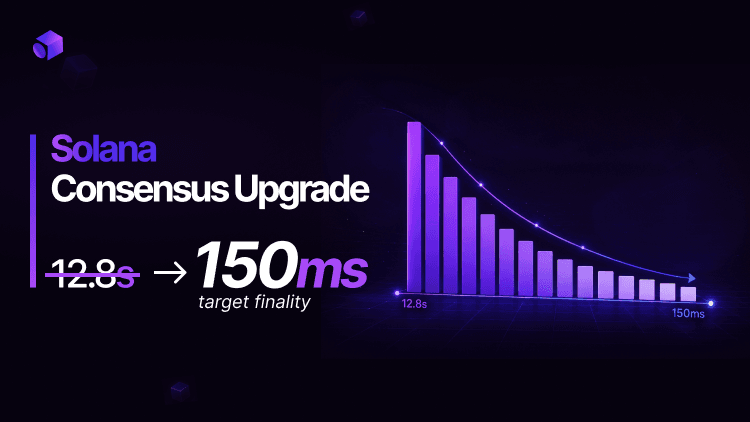
Solana's biggest consensus change since 2020 is scheduled to activate on mainnet on September 28, 2026. Most of the coverage stops at one number: finality drops from roughly 12.8 seconds to somewhere between 100 and 150 milliseconds. That number is real. It is also not the part that matters if you are the one running infrastructure on top of Solana.
A finality number is a headline. A finality mechanism change is a migration.
This piece is for the people who have to actually do something before September 28: node operators, indexer teams, and anyone whose app treats "confirmed" and "finalized" as two different states with two different timers attached.
What Alpenglow Actually Replaces
Solana currently reaches deterministic finality through two systems working together: Proof of History (PoH), which orders events, and Tower BFT, which finalizes them through a 32-round voting process where each vote is submitted as an on-chain transaction. That 32-round process is where the 12.8 seconds comes from. It is also why roughly three-quarters of all transactions on Solana today are validator votes, not user activity.
Alpenglow replaces the voting and finalization layer with a new protocol called Votor. Instead of 32 sequential on-chain votes, Votor runs one or two rounds:
- Fast path. If 80%+ of stake approves in the first round, the block finalizes in roughly 100ms.
- Slow path. If 60–80% approves, a second round runs, finalizing in roughly 150ms.
Both paths run in parallel. Whichever completes first wins. Votes are no longer on-chain transactions. Validators exchange them directly and compress them into a single aggregated certificate using BLS signatures, which frees up the block space votes used to occupy.
Alpenglow also introduces a resilience model called 20+20: the network is designed to keep finalizing blocks even if 20% of stake acts adversarially and another 20% is offline at the same time.
A second component, Rotor, will eventually replace Turbine, Solana's current block-propagation layer. Rotor ships as a separate proposal on a later timeline. It is not part of the September 28 activation. Anyone reading Alpenglow as a single monolithic upgrade is going to plan for the wrong date on half of it.
One more detail that gets glossed over: PoH is not fully gone. It stops being a consensus primitive, but Solana keeps a fixed ~400ms slot cadence with local timeout timers on each validator. The block-production rhythm you are used to does not change. What changes is how fast a block becomes irreversible.
Why "Confirmed" and "Finalized" Collapsing Into One Number Matters
Most Solana-integrated systems today are built around a gap. An app shows a transaction as "confirmed" almost immediately (Solana's existing optimistic confirmation typically lands in 500–600ms), but treats it as fully "finalized" only after that ~12.8 second window closes. That gap is where a lot of quiet architectural decisions live: cache TTLs, reorg-safety buffers, "wait before you tell the user it's final" logic.
Alpenglow collapses that distinction. Under the new model, confirmed and finalized converge into a single deterministic certificate at roughly 100–150ms. Any code path that still treats them as meaningfully different states is now working off a gap that no longer exists.
Here is where that shows up in practice.
1. RPC Caching Assumptions
If your caching layer invalidates or refreshes based on a finality window tuned to "a few seconds, to be safe," that buffer was calibrated to Tower BFT's 12.8-second worst case. Post-Alpenglow, holding onto that buffer does not make your app safer. It makes it slower than the chain underneath it. Every millisecond you are artificially withholding "final" data because you do not trust it yet is now pure latency debt.
The fix is not just shrinking the number. It is re-deriving what your cache invalidation is actually protecting against, now that the reorg window it was built for has effectively disappeared for finalized state.
2. Indexer Re-Org Handling
Indexers historically had to assume a block could still be reorganized until it was buried under enough subsequent votes, which at 32 rounds meant a meaningful window where "confirmed" data could still be wrong. Alpenglow's certificate-based finality removes most of that ambiguity for the fast and slow paths.
But re-org handling logic does not get simpler by accident. It gets simpler if someone rewrites it. Indexers that keep their old rollback logic in place are not wrong, exactly. They are just holding onto complexity, and the CPU and storage cost that comes with it, that no longer maps to how the chain behaves. Worse, if your indexer's rollback assumptions are hardcoded to old timing constants rather than derived from the actual certificate state, they can misfire in ways that are hard to catch in testing because the failure mode is rare and timing-dependent.
Solana's own upgrade documentation flags this directly: Alpenglow is a breaking change that requires indexing changes. That is not marketing language. That is the protocol team telling you this is not optional homework.
3. Webhook and Notification Debounce Logic
If you are firing "transaction finalized" webhooks or push notifications, there is a good chance your debounce window exists to avoid notifying a user twice, once optimistically and once after real finality, twelve-plus seconds apart. That two-notification pattern was a reasonable trade-off when the gap between "probably done" and "definitely done" was large enough to matter to a user.
At 100–150ms, that gap is smaller than most UI render cycles. Keeping a multi-second debounce window in place after Alpenglow activates does not protect your users from anything anymore. It just makes your app feel slower than the chain it is built on, and slower than competitors who redesigned their notification logic around the new timing.
Spin Up a Free Solana RPC EndpointWhat to Actually Check Before September 28
- Audit every place your codebase distinguishes "confirmed" from "finalized." Alpenglow does not require you to remove that distinction, but it does require you to know why you are keeping it.
- Re-derive cache TTLs and reorg buffers from the new fast/slow path timing, not the old 12.8-second assumption.
- Test your indexer against Alpenglow's testnet certificate format before mainnet activation, not after.
- If you run a validator, this is not just an application-layer concern. Validators must register new BLS public keys and pass the Validator Admission Ticket (VAT) check before they can vote under the new system, a requirement that has been active since July 2026, independent of when the consensus switch itself flips on.
- Remember Rotor is not part of this activation. Block propagation improvements come later. Do not build a testing plan that conflates the two.
Further Reading and Sources to Track
- Solana Foundation's official Alpenglow upgrade page, the primary source for activation status, breaking-change notes, and SIMD numbers.
- SIMD-0326, the original governance proposal defining Votor and the 20+20 model.
- Agave release notes (4.2 and 4.3). Agave 4.2 shipped the Alpenglow codebase for testing with the activation switch deliberately left off. Agave 4.3 carries the actual mainnet switch.
- Anza's Alpenglow bug bounty results, with adjudication concluding early September 2026, worth watching for any last-mile changes to the certificate or VAT logic before the September 28 activation date.
If you are running RPC infrastructure, indexers, or validators on Solana, the next few weeks are the window to test against this.
Talk to an ExpertFAQ
What is Solana Alpenglow?
Alpenglow is Solana's major consensus upgrade that replaces the current Tower BFT finality mechanism with a new protocol called Votor. It is designed to reduce deterministic finality from roughly 12.8 seconds to approximately 100 to 150 milliseconds.
When will Solana Alpenglow go live?
Solana Alpenglow is scheduled for mainnet activation on September 28, 2026, subject to the final activation process.
How does Alpenglow reduce Solana finality to 150ms?
Alpenglow replaces Solana's 32-round voting process with Votor, which can finalize a block in one or two rounds. The fast path requires 80% or more of stake approval and targets roughly 100ms finality, while the slower path targets roughly 150ms when 60% to 80% of stake approves in the first round.
What happens to Solana's 12.8-second finality?
The roughly 12.8-second deterministic finality window comes from the existing Tower BFT voting process. Alpenglow replaces that process, allowing finalized blocks to receive a deterministic certificate much faster.
Does Alpenglow eliminate Solana's 400ms slot time?
No. Alpenglow changes how quickly blocks reach finality, not Solana's fixed slot cadence. Solana continues producing slots at roughly 400ms intervals.
Will confirmed and finalized transactions become the same thing?
They will converge much more closely under Alpenglow. Applications that currently maintain separate logic, cache TTLs, notification delays, or reorg buffers for confirmed and finalized states should reassess those assumptions after the upgrade.
What does Alpenglow change for Solana RPC infrastructure?
RPC systems that use multi-second finality buffers may introduce unnecessary latency after Alpenglow activates. Infrastructure teams should reassess caching, data freshness, reorg handling, WebSocket notifications, and confirmation logic against the new finality model.
What does Alpenglow change for Solana indexers?
Indexers need to account for Alpenglow's certificate-based finality model. Existing rollback logic and timing assumptions built around Tower BFT may become unnecessary or require modification, particularly where applications hardcode the previous finality window.
Do Solana validators need to do anything before Alpenglow activates?
Yes. Validators need to support the Alpenglow software and complete the required validator admission and BLS public-key registration steps before participating in the new consensus mechanism.
Is Rotor part of the Alpenglow mainnet activation?
No. Rotor is a separate proposal that will replace Solana's current Turbine block propagation system on a later timeline. It should not be treated as part of the September 28 consensus activation.
What should developers check before Alpenglow activates?
Developers should audit every code path that distinguishes confirmed from finalized state, review cache TTLs and reorg buffers, test indexers against the new certificate format, and review webhook or notification debounce logic that was designed around the old 12.8-second finality window.